Festin
commissariat Simon Prud’homme, 5A Art
exposition ➨ 08/10/2021➨ 17/12/21

Emmanuelle Waeckerlé
Walking in Air in Thornton Heath
Saint-Yrieix-la-Perche : Le centre des livres d’artistes, 2021
(For the Walking Air project by Emmanuelle Waeckerlé and Will Montgomery)
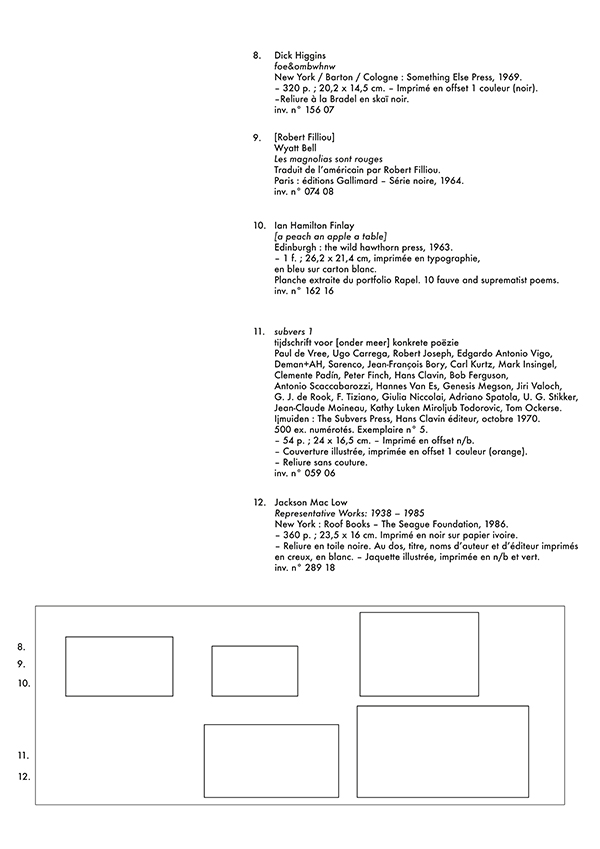
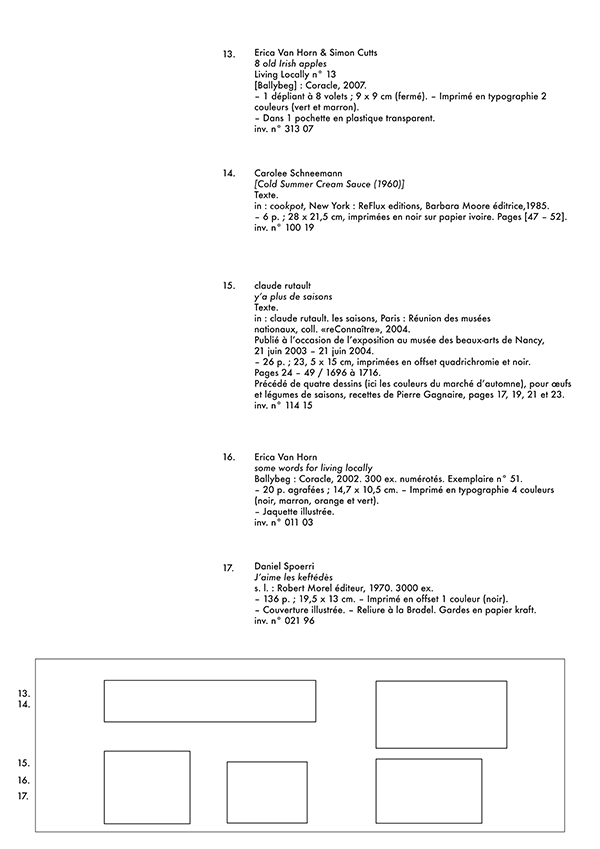
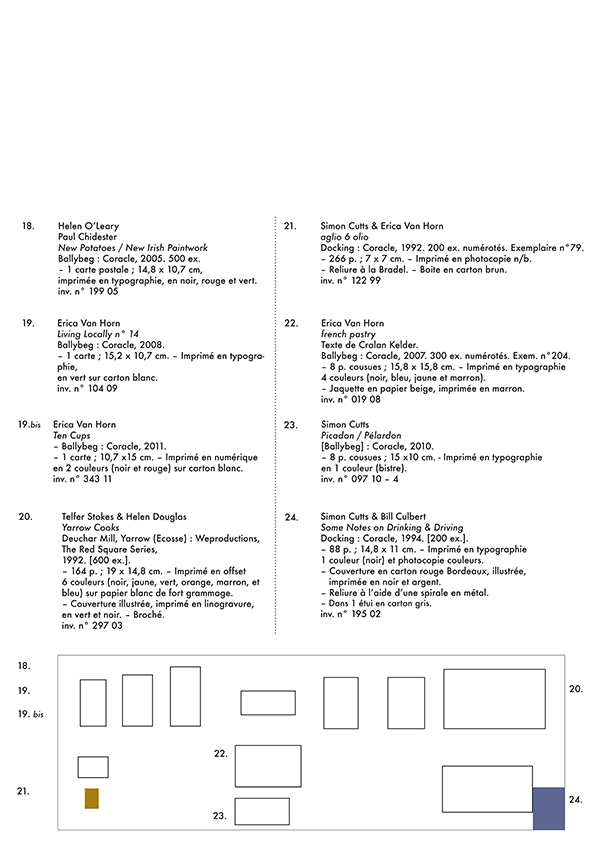
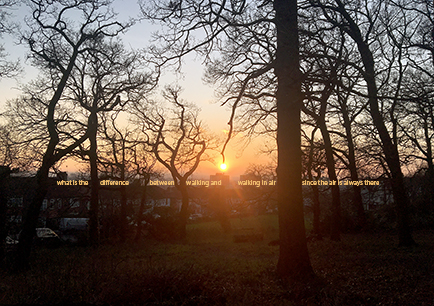
– 5 Cartes postales
– 10 x 15 cm, 250 ex.
– Impression quadri recto / noir verso 350 g
prix : 10 €
Walking in air, 19/09/2021, location 50840 Normandy 1
Walking in air, 19/09/2021, location 50840 Normandy 2
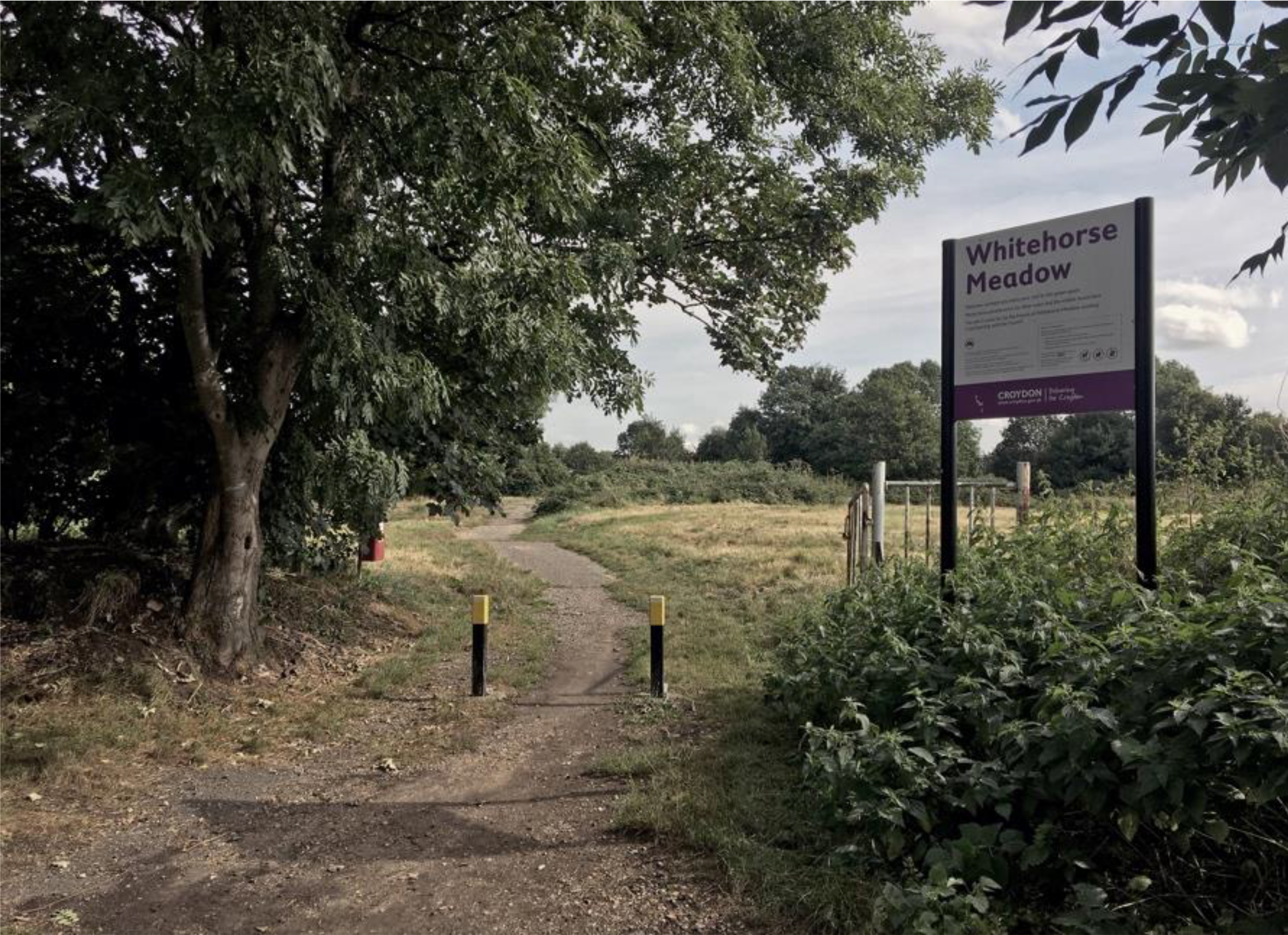
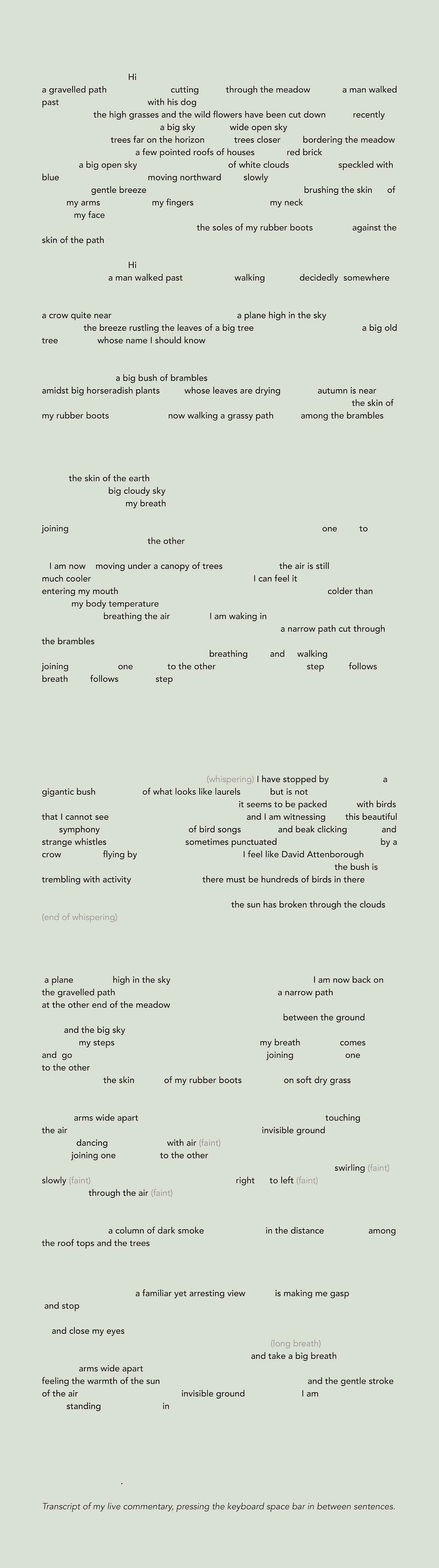
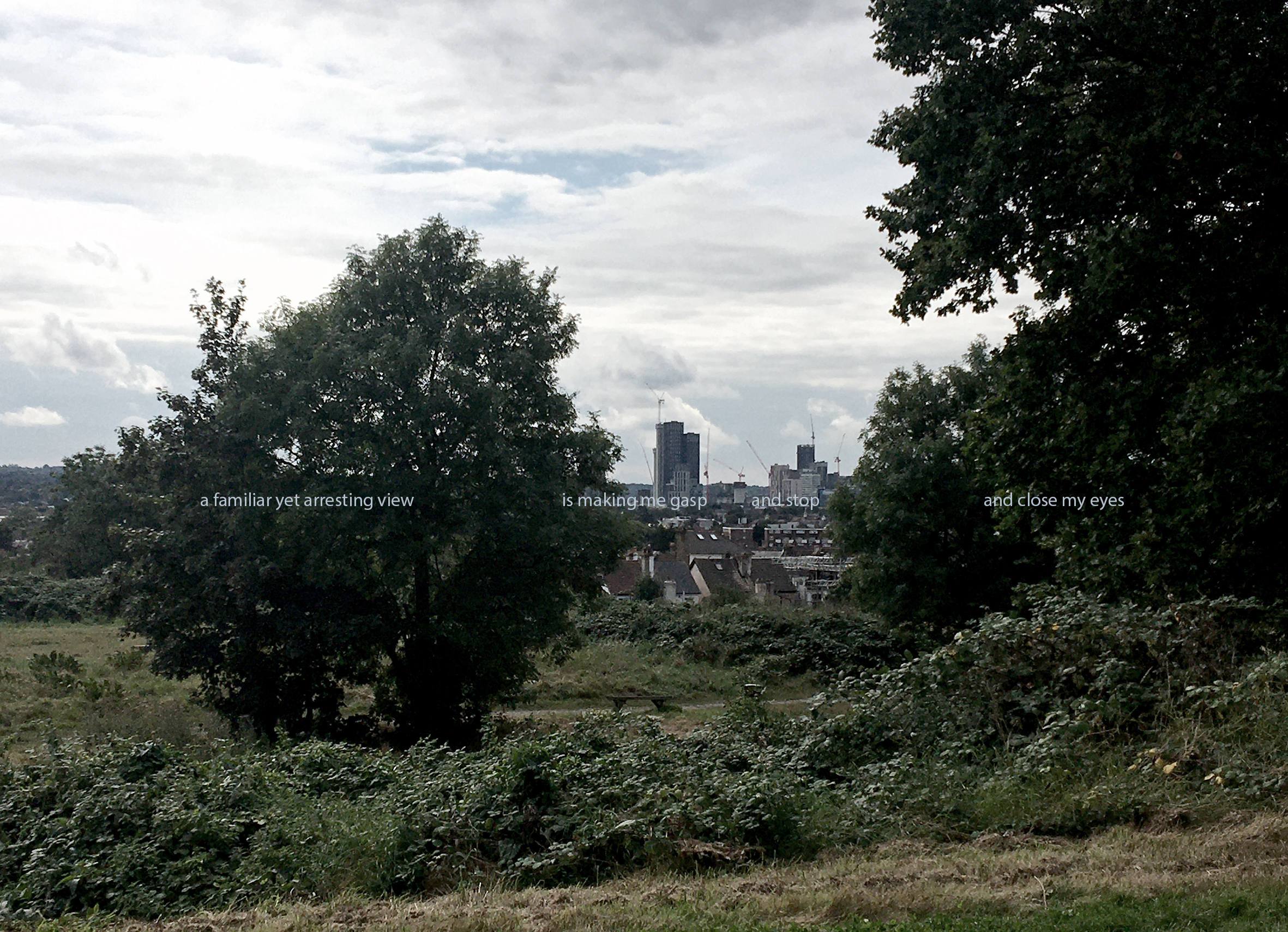
Walking in Air ‘de chez soi’ – 17/09/21 – 11.28 am

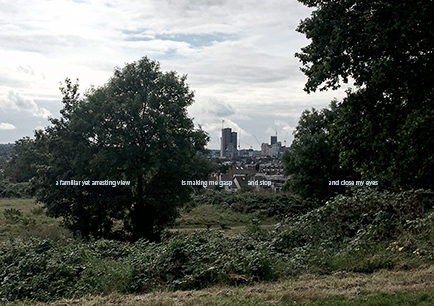
Whitehorse Meadow, SE25 London.
Walking in air in Thornton Heath, 17/09/2021,11.28am

Walking in Air ‘de chez soi’
a few notes before and after
Thornton Heath – 17/09/21, 9.48 am
Today, it is almost autumn, sunny outside finally, after a typical wet British summer and I am going to be walking in air for the second time, near my home in South London. The first time I went there to walk in air, it was on a cold January day in the middle of a long locked down winter, and it blew my mind. As I walked and paused in Whitehorse Meadow, it felt as if every particle of my body, of my mind and of my senses were dancing inside out, in on and with air. A hard act to follow, so I am trying to have no expectation beyond letting my body and my breathing do the thinking as I move through the weather world between earth and sky, joining one to the other.
As I am writing these few words on the pages of my sketchbook, I am distracted by the loud and clunky sounds of the binmen truck weekly collection in the street outside. I raise my eyes and come across this quote on my laptop screen. “As the crickets soft autumn hum is to us, so are we to the trees, as are they to the rocks and hills” (Gary Snyder’s words used by David Abrams to conclude his preface to his book “the spell of the sensuous, perception and language in a more than human world” (1997).
Walking in Air – Whitehorse Meadow, SE25 London – 17/09/21, 11.28 to 11.58 am
Thornton Heath – 17/09/21, 13.15 pm
I am now sitting in my garden, coffee in hand, not far from mamba comfortably and majestically stretched in the middle of an oversize cushion that she has claimed as her summer quarters. I hear water gurgling from the next door neighbour’s garden pond, a plane flying low over my head towards Gatwick airport, this never happened before lockdown.
I walked in air on familiar ground, from time to time thinking aloud in the weather world, zoom recorded held with both hands, arms stretched in front of me, to ensure stereo quality and minimal friction noise. It was not the mind blowing and boggling experience of my first attempt in January, but a gentle and close encounter with the ground, the sky, the air and everything, small and big, visible and invisible occupying it, a gradual becoming alert of all senses and nerve endings, while eyes, ears, skin, arms and feet danced in on and with air. My mind was happy to sit back and enjoy this pause from the chaotic juggling of my everyday, even more so now that the fast pace of life as we knew it is resuming without much warning. The only thoughts occupying her was wondering what the trees I couldn’t name, the birds and the foxes I couldn’t see but hear in the bushes and brambles, the crows, the wood pigeons, the sky, the insects, the grass, the horseradish and other wild plants, what did they all think of us ? How did they perceive us if at all. As one of them more than humans, or as hooligans responsible for the toxicity and slow demise of the environment we share.
I encountered three humans while walking in air today. One was walking his dog, another was walking purposefully fast with a full rucksack on his back, on what seemed to be some kind of circular circuit training since he passed us twice with the same speedy determination, just sweating a bit more the second time. The 3rd one was sitting on a bench next to his bicycle loaded with 2 satchels, checking his itinerary on his mobile phone. All of us walking, jogging, sitting in the same air, our breath coming and going and joining earth and sky.
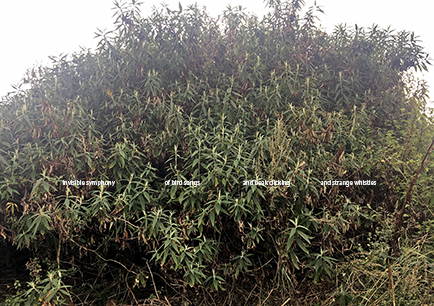
Today Monday I went back to the Meadow to find out the names of the Trees and bush I couldn’t name with the help of my trusted ‘picture this’ app. The big old tree whose leaves were rustling in the breeze is a common Ash (Fraxinus excelsior). A big Butterfly Bush (Buddleja Davidii), also known as Summer lilac, was the temporary abode of hundreds of singing and whistling birds. It was now very quiet and interestingly enough, it was not where I expected to find it: it took me a while to locate it in this small meadow that I know inside out. This made me realise that perhaps my walking in air the other day had possibly been as mind altering as that first one.
© Emmanuelle Waeckerlé 2021

Notes for Walking in Air
Carol Watts
Place
Walking on Blackheath, south-east London, 18 September 2021.
Blackheath is a flat plateau of heath and grass, which has a long and significant social history. In 1381 the Kent rebels under Wat Tyler met here with the King’s representatives during the Peasant’s Revolt (which arose out of the political tensions after the Black Death – one of the local (mistaken) apocryphal tales is that the heath was never built on, because of plague burials, hence the name)– it is a place of walking to, gathering and rallying. It is a place shaped by extraction – glacial gravel deposits dug for the London building trade and for ballast, reportedly for Versailles, bisected by Shooters Hill which is an ancient, once Roman, road. Any walk across Blackheath, at the top of an escarpment which is Greenwich, contends with crossing this traffic, which is continuous, and a low hum of endless noise, with occasional emergency vehicles; and with planes – the flightpath from a number of airports overhead, criss-crossing the sky with white contrails. It is a place of sky and clouds. Blackheath is a landing place for geese – Canada geese, Egyptian geese – and a large community of crows, occasionally starlings, ducks, sometimes a heron. It has four ponds, including one that appears and disappears. The space is currently being managed to increase biodiversity – the grass is cut for south-east Londoners to exercise, play football and fly kites, to hold spectaculars like the fireworks on November 5th, and also left as managed meadow margins, with the hay uncollected so that birds can benefit from the seeds. The grass is marked by darker circles where fungi expand their rings of spores each autumn.
During lockdown we took a walk across the heath each day, in all weathers, over months. I’ve lived close by for 27 years, but hadn’t experienced the heath in this way. The traffic reduced, the planes had stopped. It was possible to mark shifts in the everyday weather-world, and to breathe it in. There was for a while seemingly endless piercing sound from ambulances at the edge. The air was noticeably sweeter. There were also discoveries, since we were slower, not so end-focused on destination and time, noticing more. One was a small mound, slightly higher than the rest of the heath, normally passed by. Whitfield’s Mount is named for the Methodist preacher who gave sermons and sang hymns from that spot in the eighteenth-century to crowds of more than 20,000. Recently a rough sleeper built a hide there. It was a place for military target practice in the 17th century. This small elevation has been a place for speeches over the centuries: from popular rebellions and battles, to the Chartists, and suffragettes. It was originally named after Wat Tyler. It is thought that John Ball, one of the leaders of the peasants’ revolt, gave his famous sermon there :
When Adam delved and Eve span, who was then the gentleman? From the beginning all men by nature were created alike, and our bondage or servitude came in by the unjust oppression of naughty men. For if God would have had any bondmen from the beginning, he would have appointed who should be bond, and who free. And therefore I exhort you to consider that now the time is come, appointed to us by God, in which ye may (if ye will) cast off the yoke of bondage, and recover liberty.
The Mount feels like a symbolic place.
The focus of my walking lies close by the Mount. It is a ‘seasonal’ pond, which arrives in some years, and then disappears, depending on the amount of rain. It resembles the ‘ghost ponds’ now being mapped and recovered in Norfolk in the UK, in that when the water returns, various species of plant, long dormant, some thought extinct, begin growing again. This year the Blackheath seasonal pond seemed full for an extended time – reeds grew through the grass, along with water mint, ducks hung out there. There are no fish, but various amphibia sometimes return. At this moment the pond is dry, leaving a lush residue of plants, including some rare species. The water mint persists. If we have a dry winter, the pond will return to a depression in the grass, a lip in the earth.
There’s a good local summary of the connections ‘on foot’, here, with photographs. The first photo has the pond in the foreground.
Walking in Air
My aim is to walk this route to and around the seasonal pond regularly over the next months. The heath is an ‘open’ space, but one that has continually been captured and in occupation over hundreds of years. I’m interested, via this seasonal ‘ghost’ emergence and disappearance of the pond, to think about what surfaces to meet the air, how speech also finds soundings in it. This is less about tracks, and pathways, but about the process of ‘comings and goings’, as Ingold puts it, ‘such productive movements may generate formations, swellings, growths, protuberances and occurrences, but not objects’ (Ingold, Being Alive). If there are habitual tracks in the grass – which expanded in width over the last year during Covid – I’m less interested in traversals, like the Richard Long line in the grass – and more circularities, like mounds and ponds, which might seem each to be the obverse of the other. Earlier this summer I walked a Neolithic settlement, Hod Hill, in Dorset, and noticed both the curve and contours of occupation, and the Roman military rectilinear line of a later camp that had cut into it. My walking in air is less about lines than what in us and other species binds to circles, circumambulatory movements and formations. It’s also perhaps about portals, and kites.
I’ll be using drawing, poetry/voice, sound recording.
Walking in air in Solothurn, 19/09/2021, 3.15pm
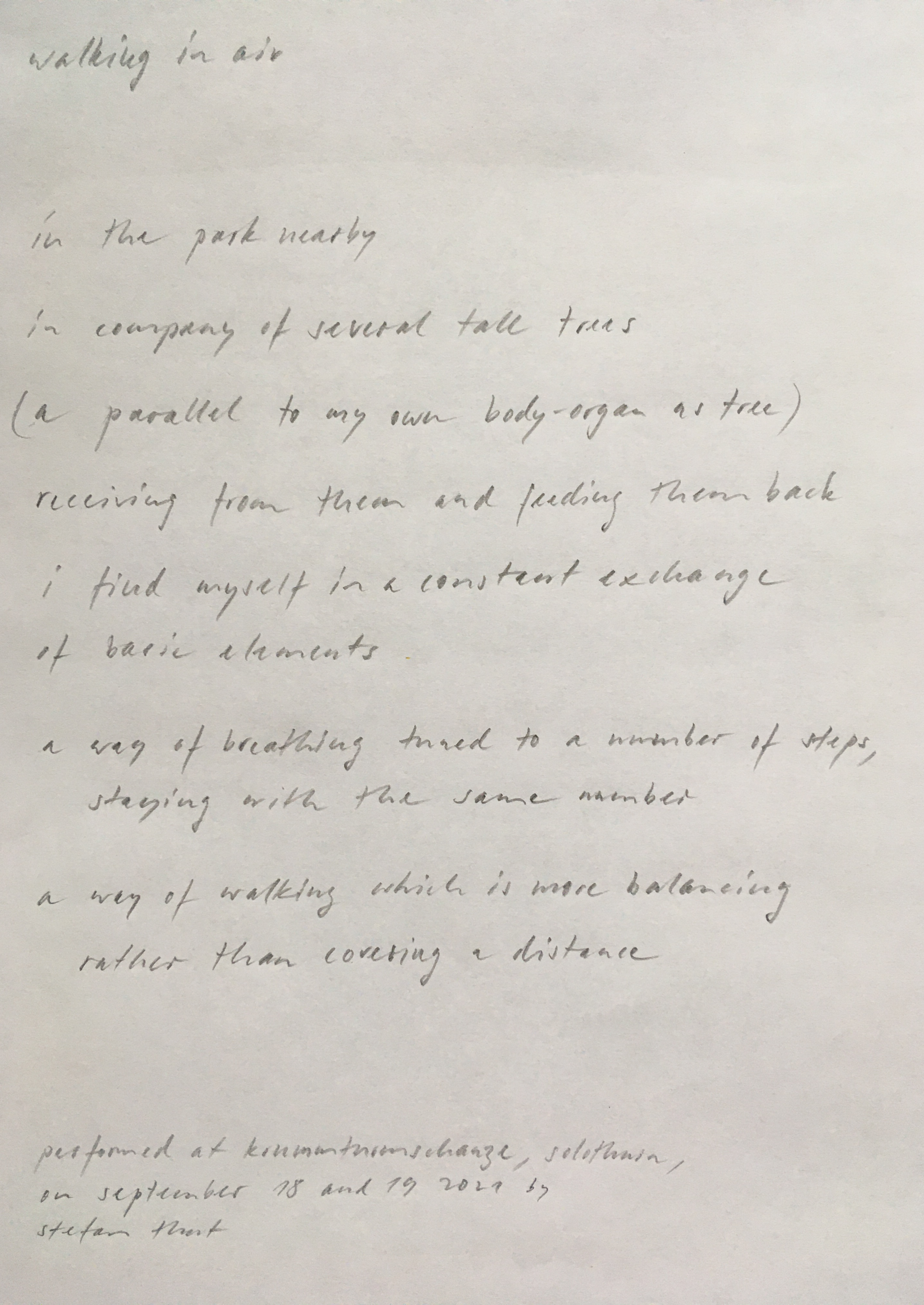
Tüllinger Hügel – September 18th
I ascended through vineyards and a garden-colony, crossed an expressway and turned right to follow a soft footpath. Dog roses and old fruittrees on both sides. Noticed that the nuts on some walnut trees were not green but black.Took a side-path mounting left after 15 minutes. Looked out for a wooden cabin I had visited 15 years ago. Found it was totally hidden in a thicket of bushes.
Squeezed myself through the thicket and found the cabin destroyed, window broken, door open. Sat on the planks in front of it. A thick green wall of bushes in front of me. Impossible to view through.
A shield. I sat a while. Turning my head over my left shoulder I spotted a book lying on the floor of the destroyed cabin. Bound in beige linnen, it’s title : Wie man Freunde gewinnt ». « How to win friends ». A robin sat close on a branch. Not irritated by my presence. Dry leaves on the planks.
Rustling as I touched them. I picked up the book and went through the pages. Smell of wet old paper. A piece of paper dropped from the pages. Traces of handwritten dates from the years 1974/75. I layed the book back on the planks in the cabin. I looked at the green thicket. I passed through my ascend to this place in air and ground and noted :
with
every
step
I
am
leaving
something
behind

Contact-mic’d fence
Will Montgomery
Walking in Air de Chez Soi
September 2021
In the days before September’s ‘Walking in Air de chez soi’, I had been reading the American poet Peter Gizzi’s ‘Poem Beginning with a Phrase from Simone Weil’, which begins with the following lines:
There is no better time than the present when we have lost
everything. It doesn’t mean rain falling
at a certain declension, at a variable speed is without
purpose or design.
The present everything is lost in time, according to laws
of physics things shift
when we lose sight of a present,
when there is no more everything. No more presence in
everything loved.
The poem is set in motion by the phrase from Weil and it works through variations on the themes of presence, loss, velocity and time. I was struck by the odd word ‘declension’, which hitches grammar to descent. In my first Walking in Air outing in January 2001 I had thought about the following words from an essay by Susan Howe: ‘Maybe the nature of a particular can be understood only in relation to sound inside the sense it quickens. Setting sun. A mourning dove compounds invisible declensions.’ As I prepared for my second walk in air, I thought about the Gizzi poem’s preoccupation with encountering the present. And about an article on Weil, in which Sharon Cameron suggests that the French thinker asks us to reconsider how we attend to the world:
Insofar as contradiction is repellent to what would make the
world intelligible, resting in contradiction (indistinguishable from
resting in attention) implies relinquishing understanding, along
with the recognition that understanding is an operation that can
only be performed in a vacuum isolated from the real, as on a
plaything. Thus attention is regard that is innocent of desire or
aspiration, hence innocent of either masochism or sadism, and
not to be explained by a psychologizing vocabulary.
Cameron, ‘The Practice of Attention: Simone Weil’s Performance
of Impersonality’
Critical Inquiry , Vol. 29, No. 2 (Winter 2003), pp. 216-252.
Cameron finds in Weil a forceful commitment to the value of the unintelligible, endorsing instead a disinterested mode of attention and an acknowledgment of indeterminacy. Getting ready to walk, I thought about this and the Gizzi poem alongside the discussion of knowledge in Tim Ingold’s article ‘Footprints through the weather-world: walking, breathing, knowing’ – Ingold argues that the walking ‘wayfarer’ encounters knowledge in a way that is ‘not classificatory but storied, not totalizing and synoptic but open-ended and exploratory’.
I decided to walk on Wolstonebury Hill in Sussex. The summit was once the site of a late Bronze-age hillfort. Open-cast mining activity in the 18th-century punched a series of declivities into the ground at the top. From the hill, one can look out over the flat plain of the Weald, which runs to the North Downs in Surrey, or East or West along the ridge of the South Downs Way, or at the wind turbines in the sea beyond Brighton.
In the first section of my walking in air, I moved upwards over a section of the ridge, following a chalk pathway running between two gates. To the north, on my right, there was a steeply curving drop. There were white sheep in the field to my left, white chalk underfoot and white clouds overhead. As I walked, I thought of a line from another Peter Gizzi poem that I had with me, ‘How to Read’: ‘A textual nimbus, air born’. Gizzi’s ‘textual nimbus’ seemed to accommodate the interpenetration of thinking and landscape as I moved along the chalk pathway.
After the second gate, I came to a wire fence that was humming in the breeze, moved by the air. I attached contact mics, plugged them into my audio recorder, and lay down in the sun. The sound of wind on wire, only faintly discernible to the ear, became deep and resonant when captured by the microphones. The occasional jogger or rambler stopped to chat, usually remarking on the warmth of the day.
After a time, I moved on towards the top of the hill. I tried to imagine what it might mean to ‘relinquish understanding’, even as I engaged in an activity that was surely guided, in one way or another, by ‘desire and aspiration’. At the top, I found a sheltered spot to lie down in – one of the bowl-like mining scars that pockmark the hill. There, I set up my recorder again. Every time an aeroplane passed overhead I sounded a note on an old pitch pipe. I addressed the huge metal machine roaring through the air above by means of air sounded as it moved through a short metal tube. (When I listened to the recording later, my piping had been so quiet that it was entirely effaced by the sound of the jet engines.)
Some time later, I made my way back to my starting point in two stages. In the first I watched a cluster of skylarks wheeling around the hilltop. Pulling out my phone, I learned that the collective noun for these birds is an ‘exaltation’. I thought again about how passing over the variegated terrain, moving though air that was soft and invisible but full of the sounds of cars and aircraft, my thoughts were modulated by my surroundings: the textual nimbus.
In the final stage of my walking in air, I passed down the easy slope of the ridge, now in declension myself. I tried to attend to the asynchronous patterning of my walking in air: footsteps moving more quickly than breath. Gizzi’s Weil poem ends:
A certain declension, a variable speed.
Is there no better presence than loss?
A grace opening to air. No better time than the present.
I ended my walking in air and walked home down the hill.






 le cdla
Vous devez être connecté pour poster un commentaire.