Paul-Armand Gette

De la pegmatite à la porcelaine ou La colère des Nymphes !
30 juin – 13 octobre
pag1web
pag2web
pag3web

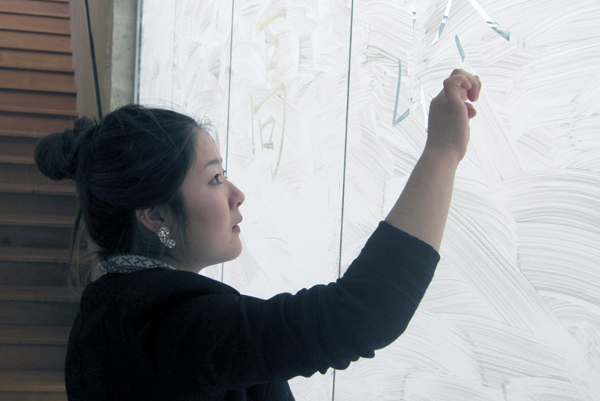
Saint-Yrieix-la-Perche est, c’est bien connu, le berceau du kaolin sans lequel la porcelaine n’existerait pas. Sans Pegmatite et sans Feldspath pas de kaolin ! Nous avons là un bel enchaînement, qui tout logique qu’il soit, ne m’aurait mené à rien. Heureusement pour moi la mythologie est venue à mon secours en me soufflant que les Nymphes limousines n’avaient guère apprécié cette ample destruction de leur habitat favori et que, quand elles en avaient l’occasion, la colère les prenait et qu’alors la vaisselle passait généralement par les fenêtres comme en ce jour du 29 juin où Amandine défenestra une potiche qui s’écrasa au sol avec un joli bruit cristallin. Paul-Armand Gette.

Microcollection

SELF INTERVIEW 
Microcollection interviewed by Elisa Bollazzi

ELISA BOLLAZZI :   when and how did you get the idea for Microcollection?
MICROCOLLECTION :  In 1990. I was visiting the Venice Biennale and, almost by chance, picked up a few fragments  accidentally fallen onto the floor from a fantastic work by Anish Kapoor. These “microparticles”, overlooked by everyone else, opened up a  new world, an illumination! They triggered a completely fresh approach to meandering from gallery to gallery, from one museum to another.

EB :  How many  fragments does Microcollection own now?
M :  More than 700, also thanks to the precious help of artists, collectors, friends that constantly send me art-particles from everywhere.

EB : What do you do with  these donations?
M:  The fragments are filed  and can be viewed under a microscope in itinerant Cabinets de Regard, in which  the viewers can sense the invisible and the real essence of art.  Minimal Art, Conceptual Art, Arte Povera,  Fontana,  Penone, Paolini, Beuys, Buren, Cragg, Long, and so on.

EB : Tell us about your Art Sowings.
M : My Art Sowings  started in 2008 with the creation of  small green areas planted and cultivated with valuable microparticles of contemporary artworks whose titles clearly show the selection criteria adopted: The 3-meter tree by Giuseppe Penone, Watermelons by Piero Gilardi, Garden by Paul McCarthy, etc.

EB : Where about? 
M :  Bozen, Milan, Basel, Singapore, Costa Rica, and so on. In 2010 in Jerago with Waiting flowerbed, an area planted with art fragments next to a bench on which sit and wait for an utopic art-garden to grow, a thought-provoking space, a meeting point,  where the work of art starts a process that changes the way we look at the “art system”. A beneficial wait to stimulate creativity and start thought spaces  in the contemplation of a growing  art garden. In 2011,  I started the so-called project Art sowings on demand based on collaboration and faith.   They will help create  a cultural-artistic humus in parks and gardens all over the world.

EB : Is there any links between picking up art fragments and planting them?
M : After long years spent picking up the “invisible”, I am now ready to return the world  what I have lovingly collected so far.

EB : Anything to add?
M : « Artists don’t make objects. Artists make mythologies. » (Anish Kapoor)

www.microcollection.it
http://hubrenard.free.fr/

Acceptez donc ce livret, mais non gratis. Il faut qu’on me donne de l’argent, afin que je puisse vous gratifier de tous les excellents livres. Ainsi donc donnant donnant car je ne saurais imprimer sans argent, et même beaucoup d’argent, fiez-vous à ceux qui l’ont appris à leurs risques et périls, et surtout à Démosthène s’exprimant ainsi : « Il faut de l’argent, sans lui tout est stérile ». Ce n’est pas parce que j’en suis avide, et si j’en parle ainsi, c’est bien malgré ma répugnance. Pourtant, sans argent, pourrais-je jamais combler vos plus ardents désirs ? Pour moi je m’efforcerai d’accomplir ma tâche sans épargner ni labeur ni dépense. Alde Manuce1498C’est Rik Gadella qui nous avait donné à lire ce texte du fameux éditeur-imprimeur vénitien via la carte de vœ

ux 1996 des éditions Picaron.